Understanding EPDM hose and its key characteristics is crucial for anyone looking to select the right rubber hose. Can EPDM hose handle hot water? Is it fuel resistant? How do you choose a good and suitable one? In this blog, we'll introduce the essential features, common media, maintenance tips, and buyer guidance of EPDM hose. Frequently asked questions and their answers are provided at the bottom of the article to help you quickly understand this rubber hose.
EPDM rubber hose refers to hoses manufactured using EPDM rubber compounds. Apart from reinforcement material, which is usually textile cord and/or steel wire, the entire hose is made of EPDM. This hose is appropriate for many industrial uses due to its resistance to weather, chemicals, water, steam and temperatures. It can work efficiently even under extreme situations. You can find it in extensive areas, such as food, chemistry, pharmaceutical, cosmetic, construction and automotive industries.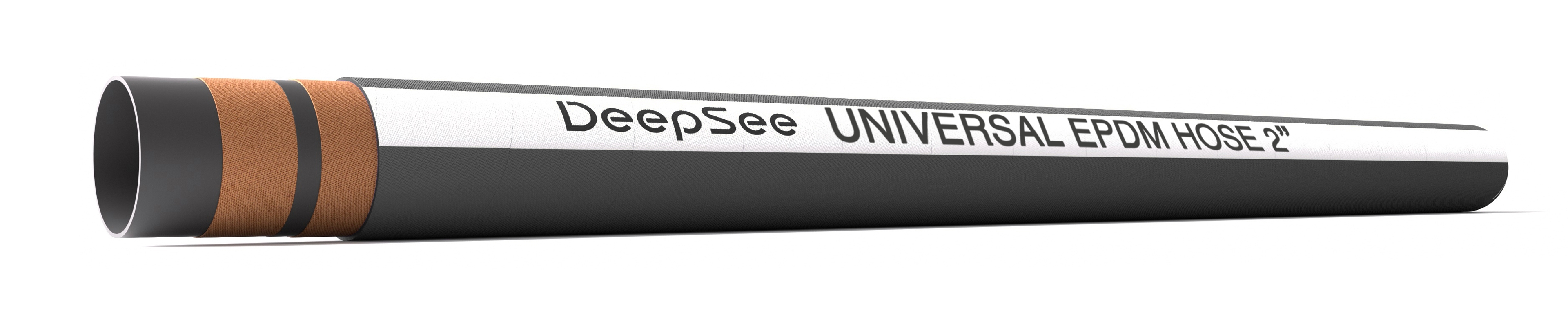
Based on manufacturing methods, EPDM hoses are divided into braided type and spiral-wrapped type. Two production processes share some similarities but also have distinct differences. Their initial and final steps are largely the same, specifically in the mixing, vulcanizing, cutting, testing, inspecting, and packaging phases. Their difference lies in hose building, which is between mixing and vulcanizing. Drawing on over 20 years of hands-on rubber hose manufacturing experience, we've understand these stages inside out, and now we'll walk you through them one by one.
1. Rubber material preparation
Take us as an example. According to the specific needs of different customers, Material Engineer Xu. and Lab Technician Peng. design a suitable rubber formula to meet practical application requirements. We use EPDM along with various compounding agents, such as fortifiers, accelerators, antioxidants, softeners, adhesives, and activators, etc., in the rubber mixing process. In addition to variations in the types and proportions of compounding agents, EPDM itself is not a fixed material—its properties vary with the weight percentage of ethylene and diene within it. Once the formulation is finalized, the raw materials are fed into the banbury mixer in a single batch for uniform blending. The mixed compound is then processed through a calender and a slitting machine to produce rubber materials in the required dimensions, either as strips or sheets.
EPDM Monomer Ratios: Effects on Hose Properties and Applications
| Monomer(s) | Proportion | Hose Property | Suitable Hose Type | Application |
| Ethylene & Propylene |
High E + Low P |
1. Stronger and stiffer 2. Better heat and steam resistance 3. Better mechanical strength and dimensional stability 4. Lower flexibility |
1. Steam hose 2. Hot water hose 3. Radiator hose 4. Air hose 5. Chemical hose |
1. Automotive (coolant & heater systems) 2. Food & beverage processing 3. Industrial manufacturing 4. HVAC 5. Chemical plants |
| High P + Low E |
1. More flexible and softer 2. Better cold performance and elasticity 3. Better dynamic fatigue resistance 4. Less strength |
1. Water hose 2. Low-pressure air hose |
1. Agriculture 2. General industrial 3. Construction 4. Food processing |
|
| Diene | High D | 1. Enhanced durability 2. Improved heat resistance 3. Faster vulcanization |
1. Steam hose 2. Hot water hose 3. Chemical hose |
1. Cleaning & sanitization 2. Chemical processing 3. Industrial laundry 4. Automotive 5. Power plants |
| Low D | 1. Lower strength 2. Reduced heat resistance 3. Slower vulcanization 4. More economical |
1. Light-duty air hose 2. General water hose 3. Irrigation hose |
1. General manufacturing facilities 2. Construction 3. Agriculture 4. Home & garden |
2. Hose building
① Braided EPDM hose
As shown in the image below, it has five layers, which means it will go through 5 procedures. First, rubber compound is extruded into a hollow inner hose with a uniform wall thickness through an cold-feed extruder. The extruded hose enters cooling water tank immediately to cool down and get shaped. Next, it is put into a high-speed braiding machine, which is 16-, 24-, 32-, or 48-spindle. Spindles holding polyester yarn balls move in interlacing circular paths. While the hose passes through the machine center, yarn is braided all over its surface, forming a tough and net-like layer. Then, it's brought to another extrusion line to apply middle rubber. This layer bonds the upper and lower braided reinforcement and reduces abrasion between them. Afterwards, it moves to the braiding area again, where it receives its second braided layer. Finally, an extruder which is different from the previous two, extrudes an EPDM cover on the hose. The outer, middle, and inner layers often utilize distinct rubber formulas due to their specific functions. In order to prevent cross-contamination and residue mixing, we always use separate extruders in these three steps. Since the year our factory was established, we have consistently adhered to this practice, so that EPDM hoses that we deliver to our customers are absolutely clean and 100% qualified.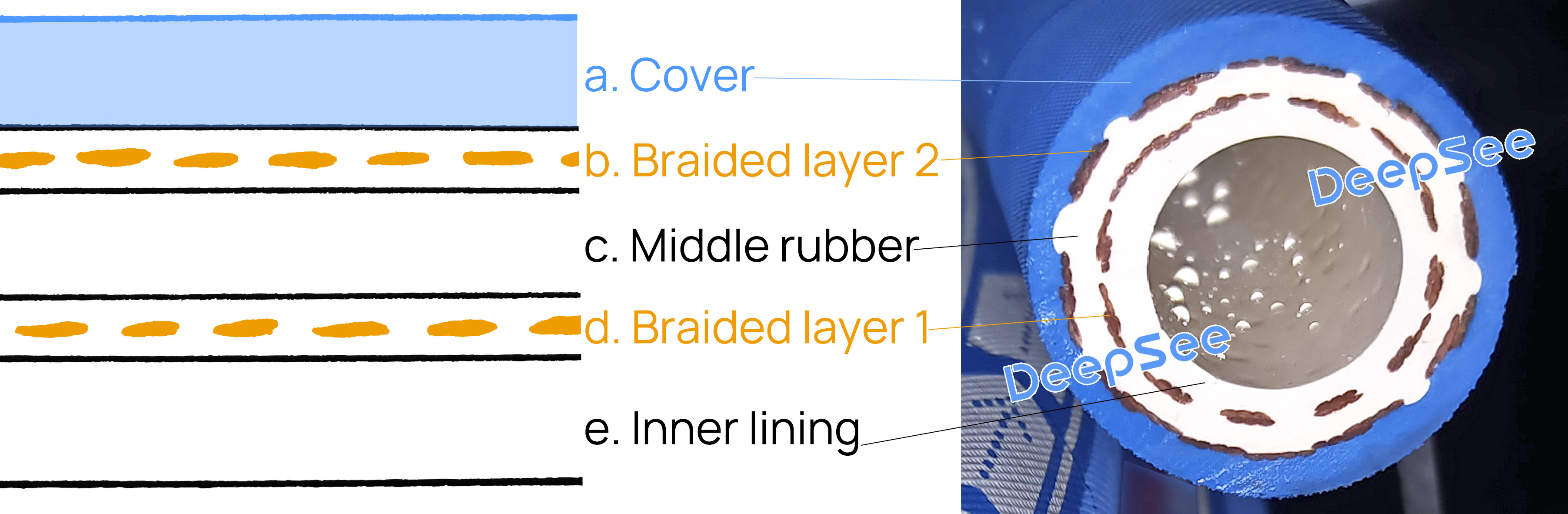
① Spiral-wrapped EPDM hose
This rubber hose's production is essentially completed on the same winding machine. First, a metal mandrel with a specified inner diameter is selected and placed onto the wrapping area by the machine from the top shelf. Our factory uses Italian fully automatic winding machines, with production lines of 13 meters, 30 meters, 40 meters, 50 meters, and 60 meters. After the operator manually sets the parameters, the machine starts working. Meanwhile, the operator stands on a movable work platform to monitor every movement and make adjustments during the process as needed, such as pausing the equipment and adjusting the wire space, or cutting the rubber strip after each winding and switching to the material required for the next step. The spiral wrapping process alternates from right to left and then to the opposite direction in a reciprocating cycle.
Taking our EPDM suction and discharge hose shown in the image below as an example, the winding machine sequentially applies the inner rubber, frictioned cord (rubber and synthetic cord hybrid), steel wires, middle rubber, frictioned cord, and the outer rubber at specific angles. Every reinforcement consists of at least one cord ply. The middle rubber penetrates and envelops the steel wires, serving to bond the adjacent layers of cord fabric.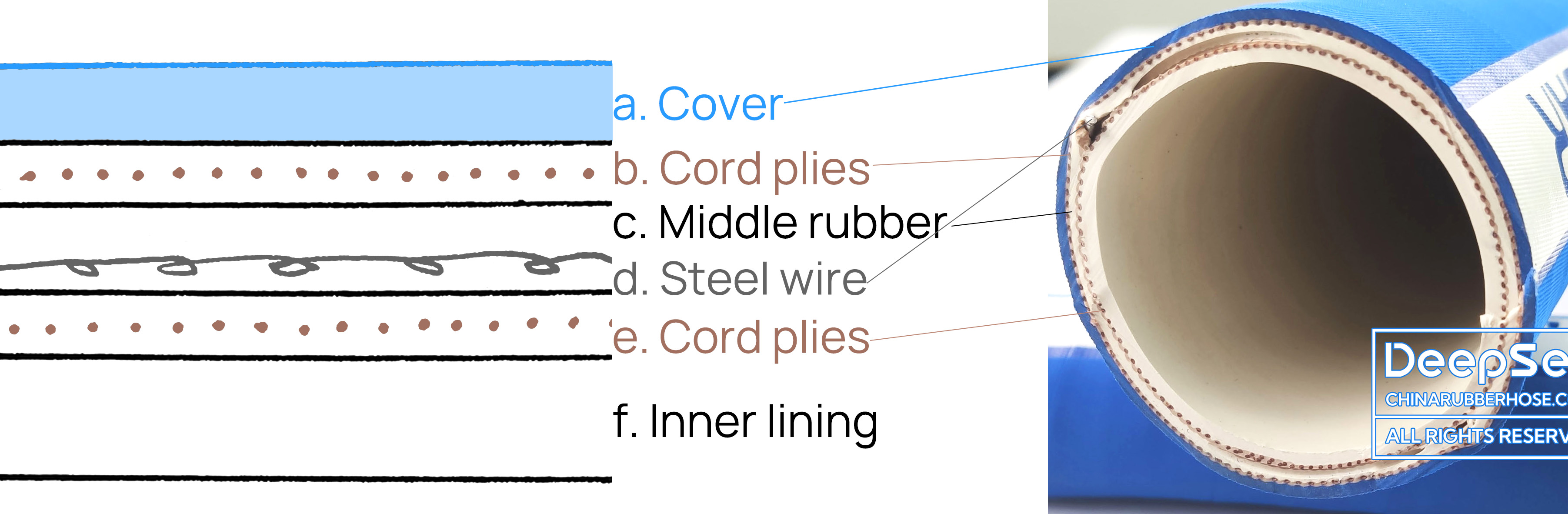
Layered schematic diagram, hose composition, and cross-sectional photo of DeepSee's spiral wrapped epdm hose
3. Vulcanization
After completing the second step, no matter braided hoses or winding hoses, are wrapped with water-soaked pressing cloth and secured with coarse ropes. Once the operator has confirmed that they are neatly arranged on pallets and the cloth is tight enough, a travelling crane is used to push the pallets along the tracks into the vulcanization tank. The door of the tank is then closed and locked, ensuring the tank can withstand subsequent internal pressure. Our operator will make sure that the door seal is intact. The vulcanization control system is often an automatic or semi-automatic temperature-pressure-time program controller. The operator sets these three parameters and starts the vulcanization process. During vulcanization, the operator continuously monitors the control instruments, observes what's happening inside the tank, and records data.
After vulcanization is complete, the exhaust valve is slowly opened to release pressure and initiate cooling. Once the temperature and pressure achieve the expected value, the tank door is opened, and the pallets containing the hoses are pulled out. Subsequently, the operators use a cloth-removal machine or tools to take off the water-soaked cloth. At last, they use a hose extraction machine to pull the hoses off the mandrel and inspect them for any obvious defects. At this point, the vulcanization process is complete.
4. Post-processing and quality control
The vulcanized industrial hoses are typically several tens of meters long. We cut them into the lengths specified by customer orders, and then grind both ends to remove burrs caused by cutting, ensuring the cross-section is smooth and even. Next, we clean the hoses with water or specialized cleaning agents and dry them. The finished hoses are then sent for pressure testing. They are considered qualified if there is no leakage, bulging, or rupture. After that, inspectors carefully check the appearance for scars, scratches, bubbles, or deformation, and also verify whether the hose dimensions, such as inner diameter, outer diameter, and length, meet the requirements. Afterall these inspections and tests, the inner and outer walls of the hoses undergo a final cleaning. Once the hoses are dried, they are packaged and prepared for shipment.
EPDM hose is highly resistant to UV radiation, ozone, weathering and harsh environmental conditions. Ultraviolet light is one of the main reasons that cause material aging. It won’t significantly degrade, crack or discolor with long-term sun exposure. As a result, it’s ideal for outdoor applications like cooling systems for cars.
EPDM rubber hose shows high resistance to a number of chemicals, for instance, diluted acids and diluted alkalis. It is also compatible with polar solvents, such as alcohol, glycols, and ketones, therefore the hose can discharge cooling fluids, detergents, and cleaning agents.
EPDM hoses can perform effectively in cold climates without becoming brittle and resist heat. They can withstand continuous exposure to high temperatures up to 150°C (302°F) and remain flexible at -40°C (-40°F). Such properties make it a preferred choice for cooling system hoses and hot water system. Radiator hose is a typical example. It delivers water and coolants. EPDM rubber can meet the temperature requirements of both the upper radiator hose and lower radiator hose, which transfers hot fluid and cold fluid respectively. Having a wide range of working temperatures also prevents EPDM hose from thermal aging and freezing.
Another crucial feature of EPDM hoses is its low permeability to water, humidity, and moisture, which means that it doesn’t allow water to easily pass through. This characteristic helps maintain the integrity of the hose and prevent leaks. Rubber hoses can contain and transport water without loss or contamination. Water resistance keeps the hose flexible and robust in wet operating environments. Being waterproof and heat-resisting makes EPDM flexible hose perfect for hot water and steam applications, such as steam cleaning, steam sanitization, and heating systems.
After the rubber hose is used, EPDM can be recycled. EPDM rubber hose has no toxic chemicals, so it’s harmless to the environment and safe for humans. This is also one of the reasons why many rubber hoses for food and drinking water are made of Ethylene Propylene Diene Monomer.
EPDM Rubber Hose Specifications
| Material | EPDM rubber |
| Reinforcement | Steel wire and polyester cord/Braided synthetic textile/Wrapped synthetic textile |
| Function | Suction and discharge/Only for delivery |
| Hose type | EPDM water/steam/chemical/food/radiator/isolation hose |
| Structure | Mandrel hose, winding structure/Extruded hose, braided structure |
| Services offered | OEM, ODM |
| Conductivity | Manufacture according to transfer requirements and working conditions |
| Temperature | -40℃~150℃ (-40°F~302°F) |
| Pressure rating | Mainly 5-40 bar, others can also be made |
| Inner diameter | 6mm-203mm |
| Length | 40m, 60m, 100m, ..., cuttable |
| Safety factor | 3:1, 4:1, or 10:1, depend on products |
EPDM hose can handle many mild chemicals. Here are some of the acids and bases that it can deliver with excellent performance.
Acid: Acetic acid, Arsenic acid, Boric acid, Citric acid, Formic acid, Fluoroboric acid, Fluorosilicic acid, Hydrobromic acid, Hydrofluosilicic acid, Methanoic acid, Oxalic acid, Phosphoric acid, Sulfurous acid, Tannic acid
Base: Aluminum hydroxide, Ammonium hydroxide, Barium hydroxide, Calcium hydroxide, Dimethylamine, Ethylene diamine, Magnesium hydroxide, Potassium hydroxide, Sodium bicarbonate, Sodium carbonate, Sodium hydroxide, Sodium peroxide, Triethanolamine
 EPDM materials are resistant to so many chemicals, however, they cannot deal with most of the strong acids and alkalis. In this case, our chemical hose with an inner lining made of UHMWPE fills the gap. UHMWPE (Ultrahigh Molecular Weight Polyethylene) can handle lots of chemicals that EPDM fails to do. This dramatically expands the range of chemicals that an EPDM hose can withstand, allowing DeepSee® EPDM chemical hose to transfer more acids and alkalis and satisfy customers’ requirements better. The chemical resistance table below shows the difference between EPDM and UHMWPE on some mediums.
 All data mentioned in this article comes from the performance of each material under the temperature of 20℃ (68℉) unless noted. Chemical resistance varies according to different concentrations and temperatures. Take nitric acid and sulfuric acid as an example. As the concentration increases, both EPDM and UHMWPE show poorer property against the acid. While EPDM rubber is greatly resistant to 10%-50% acetic acid, its performance is slightly weakened facing glacial acetic acid.
 Here are some other mediums and how the two materials react to them.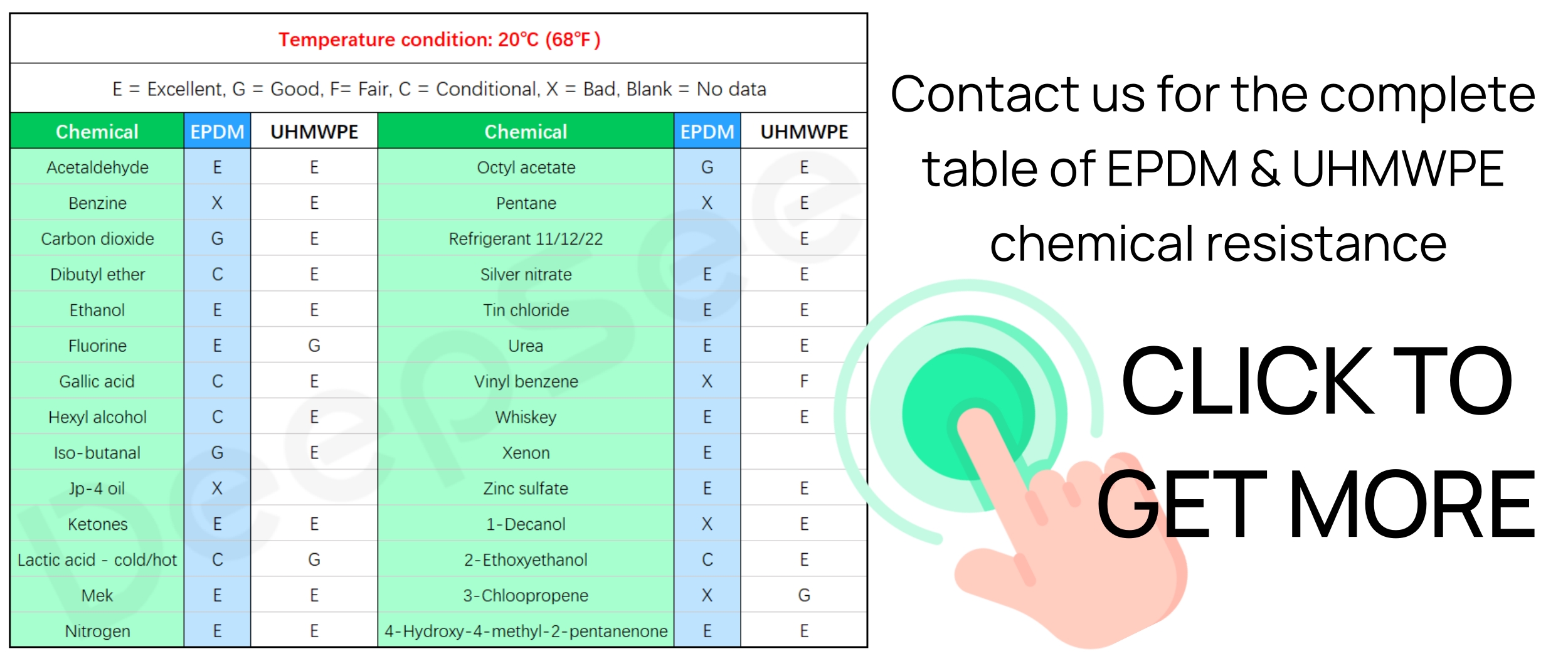
Low grease is a common characteristic of foods that are compatible with EPDM. They are either oil-free or contain little fat. These foods and drinks usually have a high water content, low-alcohol, or/and mildly acidic or neutral. The following are some examples.
Water-based liquids: drinking water, carbonated water, coffee/tea/juice (without milk), lemonade, sport drinks, soft drinks
Dairy products: low-fat milk, skimmed milk, buttermilk, whey, light cream, whipping cream, yoghurt, low-fat dairy beverages (e.g., Kefir, flavored dairy drinks)
Alcoholic beverages: beer, wine, mead, cider, sake, cocktails (below 20% ABV), light liquors (e.g., schnapps, low-alcohol liqueurs)
Non-oily food products: fruit purees, jams, jellies, syrup (e.g., sugar syrup, maple syrup), molasses, honey, non-dairy milk alternatives (e.g., almond milk, oat milk, rice milk)
Sauces and dressings: vinegar, mustard, Salsa, Salsa Verde, soy sauce, hot sauce (e.g., Tabasco, Sriracha), fish sauce, barbecue sauce, Béchamel sauce, teriyaki sauce, Worcestershire sauce, tamarind sauce, chili garlic sauce, Aji sauce, tahini sauce
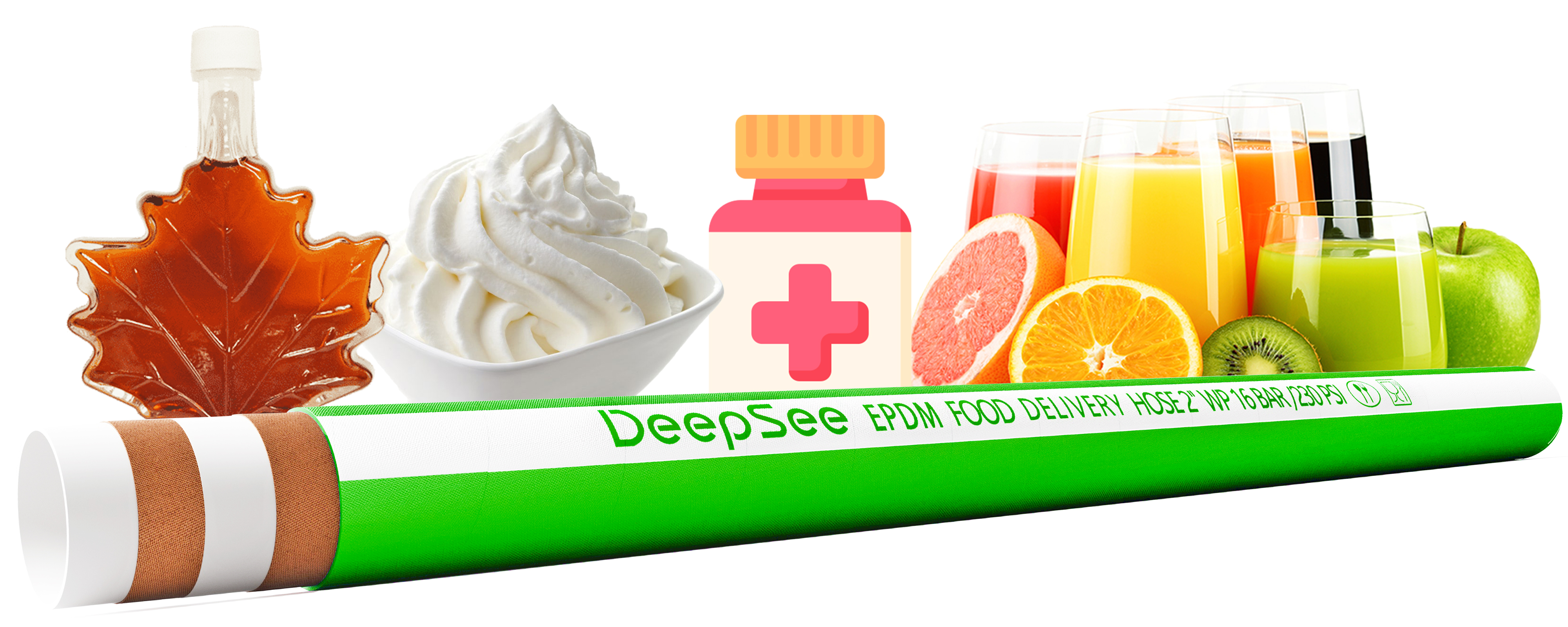
Owing to EPDM’s non-reactive nature and its great resistance against mild chemicals, EPDM rubber hoses are often utilized in the pharmaceutical and cosmetic industries, which strictly require purity and safety. They can easily handle daily cosmetics, such as facial cleanser, cream and lotion, shampoo, conditioner without oil, body wash, and hair gel. When it comes to pharmacy, EPDM hose does a good job as well. It can deal with the production and transportation of saline solutions, glucose solutions, liquid vitamins, antibiotics, and supplements, and water-based ointments.
EPDM hoses can deliver air and inert gas like nitrogen (N₂), helium (He), and argon (Ar). DeepSee® EPDM Air Hose is made up of red or yellow outer rubber, white reinforcement rubber, and black inner lining. Inner diameter can be customized from 6mm to 102mm according to your needs. Apart from gaseous mediums, EPDM hoses are also very good at handling high-temperature steam and water. Our hot water and steam hose can perform well even if the working temperature reaches 150℃. This makes the product popular in medium-pressure steam applications, industrial cleaning, sterilization, and sanitization.


Although EPDM hose can transfer lots of things and be applicated to many industries, it is not suitable for touching oil-based substances. Most hydrocarbon cause EPDM rubber to swell and degrade. The hose has excellent chemical compatibility and guarantees hygiene and safety, but please avoid using them to discharge mediums with a high oil content. For oil and fuel, DeepSee® Oil Hose can help. For greasy food, please choose our FDA Food Hose. They are a much better choice for oily fluid.
Proper use and maintenance can keep EPDM hose at the optimum state; thus, it can work effectively for longer time. Here is some basic and practical advice. First of all, check the hose regularly to prevent leaks or failure. If there are cracks, wear, or soft spots, replace or repair it in time. After use, wash the inner hose wall with appropriate detergents or water, especially for food hose and chemical hose. Besides, EPDM hoses should be kept away from oil and its incompatible chemicals. Store them separately in a cool and dry place without direct sunlight. When operating the hoses, avoid excessive stress and heat, kink, and sharp bend.
As an ideal product for industrial systems, EPDM rubber hose can deliver food, chemicals, gas, water, and steam due to its resistance to hard environmental factors and these fluids. Handling hoses in the right way can not only extend their lifespan, but also ensure the whole work to be safe. For professional rubber hose design and high-quality EPDM hose manufacture, please pick DeepSee, which was born to provide the world with useful and durable rubber hose. No matter what you want your hose to transfer, we can make it.
1. What is EPDM hose?
It's a kind of rubber hose made of Ethylene Propylene Diene Monomer. In general, its inner lining, middle layer (excluding reinforcement material), and cover are all built up with EPDM rubber. To know more about EPDM, please click here.
2. What is EPDM hose used for?
EPDM rubber hoses serve a broad range of applications, including agriculture, automotive, construction, and general industry, for the transfer of gases and liquids, as well as for handling food products, chemicals, and pharmaceutical materials.
3. Is EPDM hose fuel and oil resistant?
No, it isn't resistant to fuel and oil. EPDM rubber hose withstands harsh weather, ozone, high and low temperatures, UV, moisture, and many chemicals, but it's not suitable for oil-based substances. Hydraulic oil, petroleum, fuel, and other hydrocarbons will degrade the hose.
4. Is there a standard for EPDM hoses?
Yes, EPDM hoses do have standards, which standard is used to design and manufacture them depends on the hose's intended application and operating environment. Here are some examples of different EPDM hoses.
|
Type of EPDM Hose |
Standard |
|
EPDM Air Hose |
ISO 2398 |
|
EPDM Steam Hose |
ISO 2398 |
|
EPDM Hot Water Hose |
ISO 2398 |
|
EPDM Chemical Hose |
EN 12115 |
|
EPDM Food Hose |
FDA, GB/T 28605 |
We can produce EPDM hoses according to customer's requested standards.
5. What is EPDM air hose?
It's a flexible rubber hose formulated with EPDM rubber material designed specifically for delivering compressed air.
6. Is an EPDM hose safe for drinking water?
Yes, but only when it's certified as food grade. The hose should be specially manufactured for potable water and carries proper certifications like NSF, WRAS, or FDA. Otherwise, taste, odor, and rubber compounds may contaminate the water, making it not safe for human to drink.

