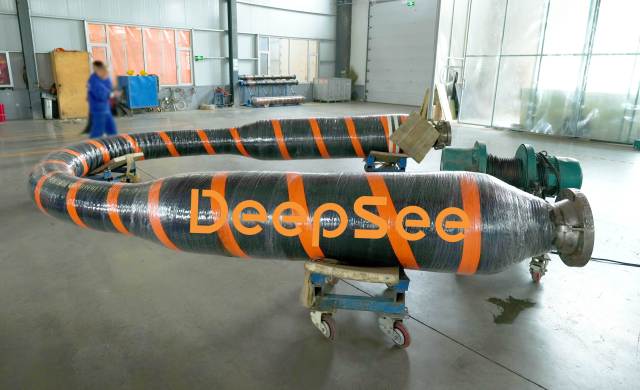
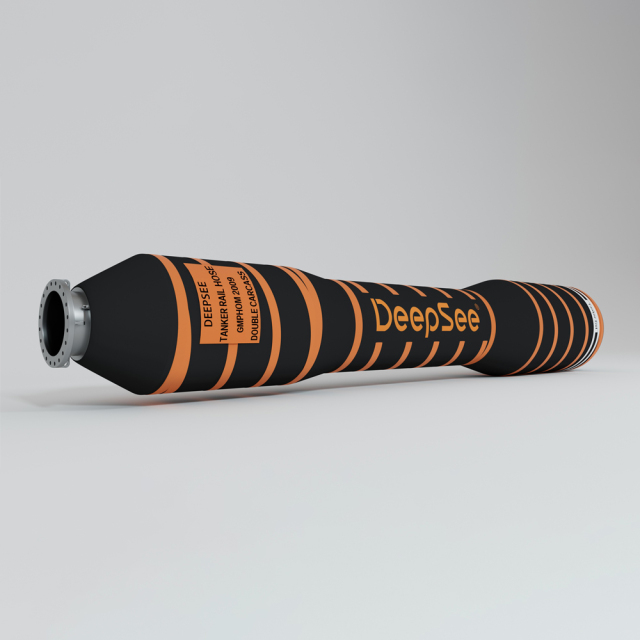
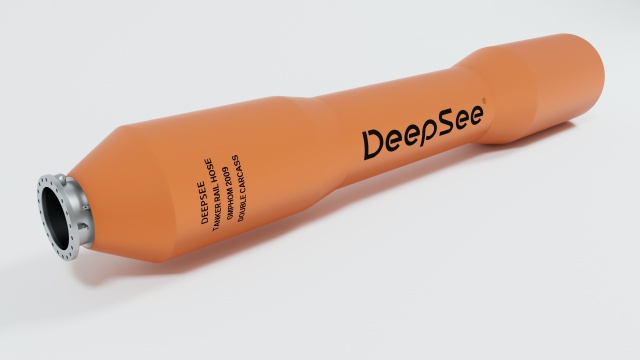
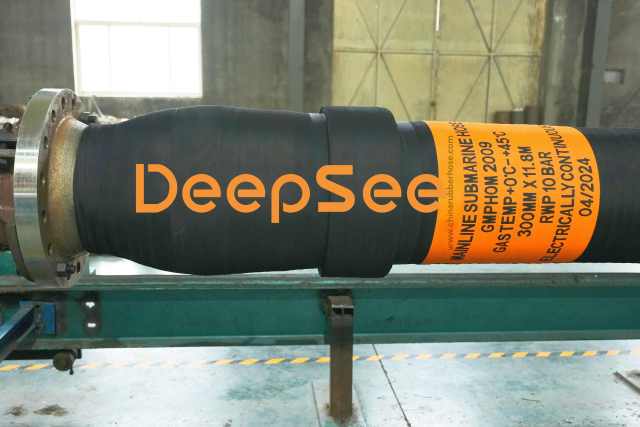
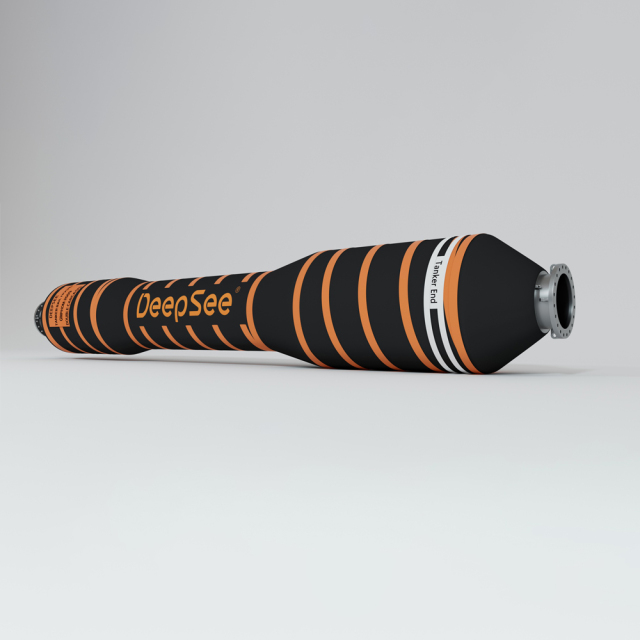
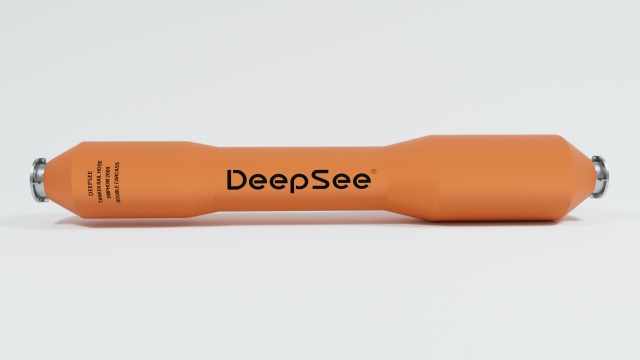
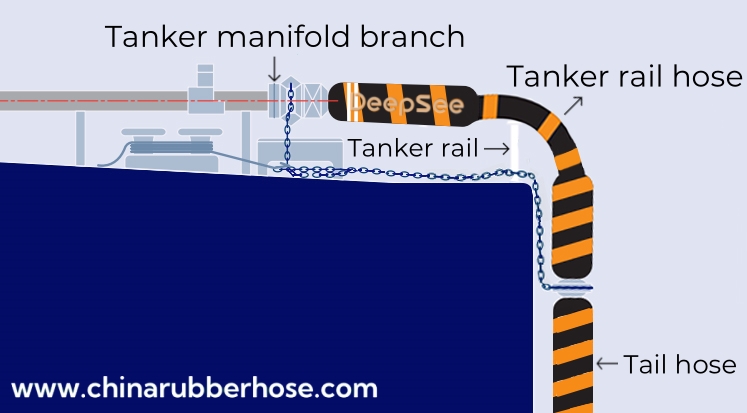
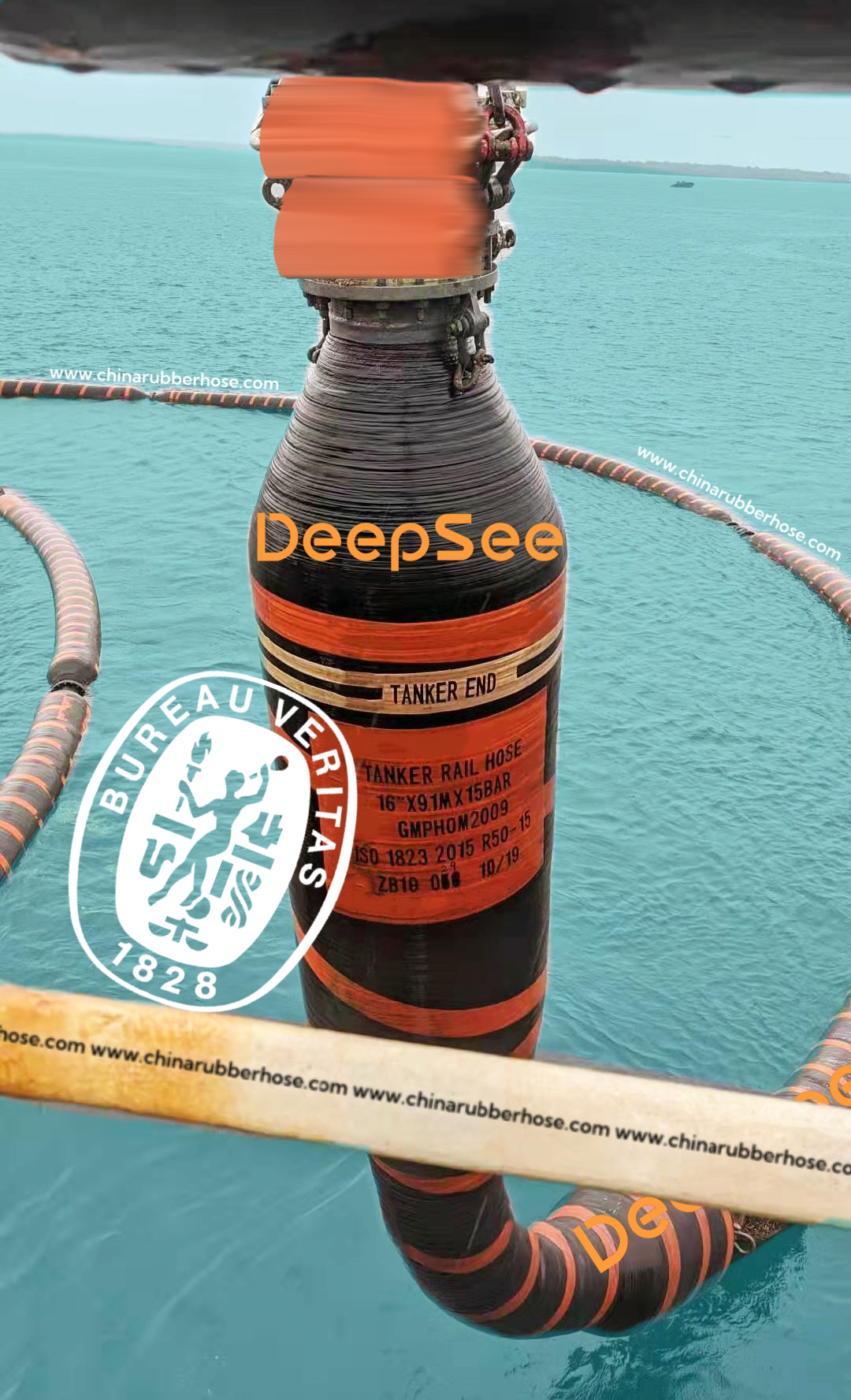
Tanker rail hose is an reinforced hose that connects the tanker manifold branch and the tail hose. Lifting lugs are included in this product. It can be used as the first off FPSO offloading hose as well.
In most offshore mooring systems, tanker rail floating hose is used to connect the ship's manifold and the floating hose strings. Its center lays on the tanker rail. This part has minimal buoyancy compared to the two sides. Though this hose looks like a dumbbell, two ends are not exactly the same, no matter from the size or inherent buoyancy. To provide more flotage for the valve and coupling device, the side that connects the tanker holds more buoyancy than the other side outboard. Connecting the bigger end to the tanker manifold can help to protect the equipment. Two white stripes are a sign of the tanker end. Proper installation and use will make hoses more durable and allow the transfer process to be safer and more efficient.
The end of tanker rail hose that connects with either the tanker or FPSO unit is reinforced. Generally, hard pipelines, no matter underwater or above the sea, are connected with marine hoses that are reinforced.

Compared to single carcass, tanker rail hose with double carcass has conspicuous advantages. It is born with a leak alarm system. This means that when the first carcass is broken, the fluid will flow to the double carcass without spilling into the sea. Meanwhile, the operator will be notified by the alarm light on the hose. Choosing a dual carcass marine hose is always the most secure decision. Though the second carcass can work well after the failure of the inner one, you should fix the problem as soon as possible by repairing the old hose or replacing it with a new hose.
→Inner layer: NBR (Nitrile-Butadiene Rubber)
Feature: Resistant to fuel and oil; Smooth; Seamless
→Reinforcement: Multiple layers of high-strength textile cord + Embedded spiral steel wire
→Outer layer: Black synthetic rubber; Spiral orange stripes on the surface
Feature: Smooth; Resistant to abrasion, oil, sea water, and sunlight/UV ray
→Floating material: Closed-cell foam
→Minimum burst pressure
Primary carcass: 5 × Rated Working Pressure
Secondary carcass: 2 × Rated Working Pressure
If you need single carcass tanker rail floating hose, please click here.
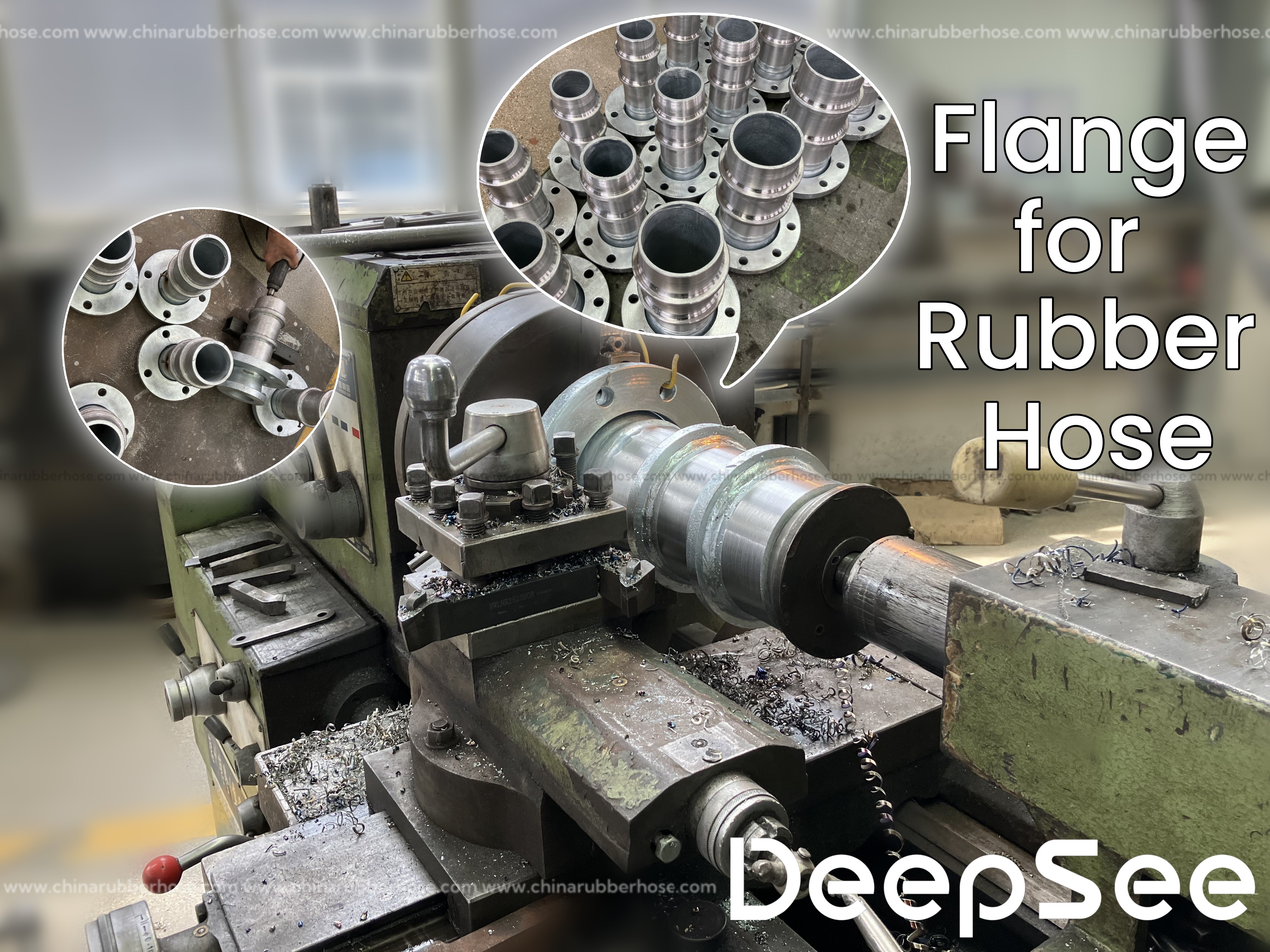
→Fittings: ASME B 16.5 (Class 150, 300, 400, 600, 900, 1500, and 2500) or other standards flanges according to customer's request will be welded on the raised face, flat face, or other required face of the hose neck. Flange material options include carbon steel and stainless steel. There are several welding and sealing methods for you to choose.
→Flange standard: ANSI, GB, JIS, or DIN.
The provided lifting lug is able to sustain loads.
Minimum breaking load:
12" = 100kN
16" = 150kN
20" = 200kN
Left: Inner diameter of the hose (inch)
Right: Safe working load limit (kiloNewton)
Test Report & Technical Analysis
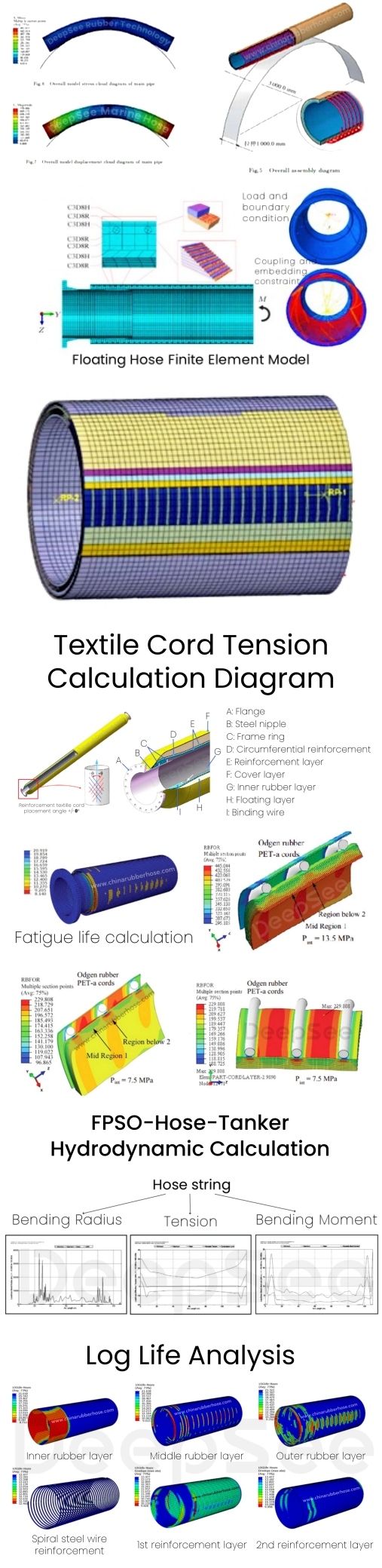
We use finite element analysis software ABAQUS to:
- Create a detailed local model of the hose to calculate hose strength, such as cord tension, rebar stress, rubber strain
- Build a detailed hose model and calculate the bending, tensile and torsional stiffness of the hose
- Calculate cord tension, rebar stress, and rubber strain under certain loads
When designing marine hoses, we do dynamic analysis and hydrodynamic calculations with the help of OrcaFlex. Dynamic responses of marine hoses are simulated under environmental loadings like wind, currents, and waves. For hoses are applicated in mooring systems like SPM, we analyze tension of mooring lines in different sea states and mooring point’s motion and displacement under various dynamic loads.
Import the ABAQUS static analysis results into the fatigue analysis software fe-safe, select the fatigue analysis theory, set the material parameters of each structural layer, load the above load spectrum, and we can get the fatigue analysis results.